


Tesla is the most polarizing stock on Earth. With a market capitalization exceeding $1.3 trillion and a price-to-earnings ratio near 200, it has become the purest expression of a single question: are investors buying a car company, or are they buying the future of artificial intelligence, robotics, and energy? The answer to that question will decide whether Tesla is the greatest investment of the decade or the most spectacular bubble of the 2020s.
Historical Context
Tesla’s valuation journey has been extraordinary. In 2010, the company went public at $17 per share with fewer than 1,000 cars sold and no profits. For most of the 2010s, it traded as a high-growth electric-vehicle disruptor with P/E ratios between 50 and 100 during optimistic periods, yet it frequently posted losses.
The turning point arrived in 2020. Pandemic stimulus, inclusion in the S&P 500, and skyrocketing demand for electric vehicles pushed the stock from $90 (pre-split) to over $400 in twelve months. By late 2021, Tesla briefly became the first auto manufacturer to reach a $1 trillion valuation. Its forward P/E peaked above 350 during the 2021 frenzy.
A brutal 2022 bear market cut the stock by two-thirds and compressed the P/E below 30 at its lowest point. Many declared the story over. Since early 2023, however, the stock has tripled again, driven by new narratives: Full Self-Driving software, robotaxis, humanoid robots (Optimus), and explosive energy-storage growth. Today the P/E sits near 200 once more, higher than almost any large company in history outside the dot-com bubble.
The Core Issue
At its root, Tesla’s valuation rests on a simple disagreement about the future earnings trajectory.
Traditional automakers trade between 6 and 12 times earnings because car sales grow slowly and margins remain thin. Even luxury peers like Ferrari rarely exceed 35 times earnings.
Tesla currently earns roughly $2.20 per share from selling cars, batteries, and regulatory credits. At $430 per share, the market pays 200 times current earnings. For that multiple to make sense using conventional auto metrics, Tesla would need to generate profits comparable to Apple or Toyota within a few years while facing brutal competition from BYD, Volkswagen, and legacy manufacturers. Most analysts consider that impossible.
Therefore, the 200x multiple only becomes rational if Tesla successfully transforms into something far larger than a car company. The market has assigned tens or hundreds of billions of dollars to businesses that do not yet produce meaningful revenue: a global robotaxi network, licensing of autonomous-driving software, and mass production of humanoid robots. These ventures could theoretically produce software-like margins of 70% or higher and scale globally.
In short, Tesla’s valuation is the stock market’s biggest bet on technological disruption succeeding at unprecedented speed and scale.
What the Market Is Actually Betting On (and Against)
The entire 200x premium boils down to one wager: Tesla will stop being “mostly a car company” and become three new trillion-dollar businesses rolled into one.
The market is betting Tesla becomes:
- The owner/operator of the world’s largest robotaxi fleet (think Uber with no drivers and 70%+ margins).
- The monopoly provider of unsupervised autonomous-driving software that it can license to every other carmaker.
- The first company to mass-produce useful humanoid robots (Optimus) at a price low enough to replace human labor in factories, warehouses, and eventually homes.
The market is betting against Tesla remaining:
- Primarily an electric-car manufacturer competing on price and volume with BYD, Volkswagen, General Motors, and a dozen Chinese brands.
- A hardware company with typical auto gross margins in the teens or low twenties.
- A business whose growth is capped by how many $40,000 to $100,000 vehicles it can build and sell each year.
In plain numbers, the market has already priced in an astonishing future. Roughly seventy to eighty percent of Tesla’s $1.34 trillion valuation today is riding on robotaxis and humanoid robots, two businesses that generated essentially zero revenue in 2025. The breakdown looks like this:
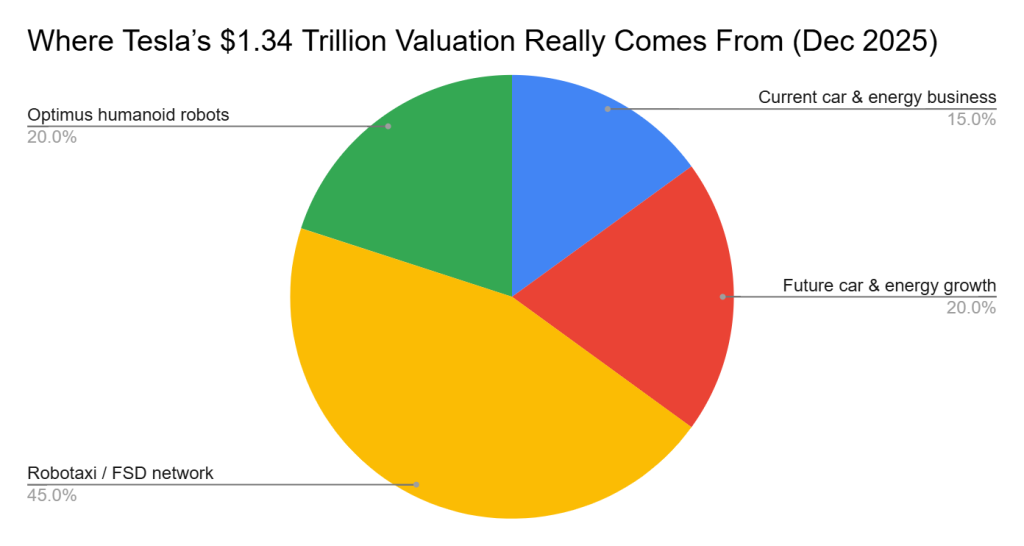
Where Tesla’s $1.34 Trillion Valuation Really Comes From (December 2025)
70–80 % of the market cap is already assigned to businesses that do not yet exist at scale.
Future Outlook
Three primary scenarios exist.
- Bull Case (Earnings Explode) Full Self-Driving reaches unsupervised autonomy by 2026 or 2027. Tesla launches a purpose-built robotaxi. Millions of existing vehicles join the network. Margins soar toward 70%. Optimus robots enter factories and homes by the end of the decade. Earnings per share reach $20 to $50 by 2030. The current price proves conservative.
- Base Case (Strong but Normal Growth) Tesla remains the leading electric-vehicle maker and grows energy storage rapidly. Autonomy improves but faces regulatory delays and competition. Robotaxis operate in limited regions with human supervision. Earnings grow to $8 to $12 per share by 2030. The stock appears significantly overvalued today and corrects sharply.
- Bear Case (Stagnation or Disruption) Chinese competitors dominate affordable electric vehicles. Autonomy proves far harder than expected. Regulators slow robotaxi deployment. Optimus remains a prototype. Earnings stall at $4 to $6 per share. The stock could fall 70% or more to reach traditional valuation levels.
Most Wall Street firms lean toward the base or bear outcomes, with median price targets around $380 to $400. A minority of optimistic analysts project $600 to $1,000 if even partial success occurs in autonomy and robotics.
Portfolio Tips for Investors
- Size matters. Tesla is a high-conviction idea, not a diversified holding. Few professional investors allocate more than 5% to 10% of a portfolio to a single stock with this risk profile.
- Understand your own thesis. Ask yourself honestly whether you believe Tesla will dominate robotaxis and humanoid robots. If you view it primarily as a car company, the current price is difficult to justify.
- Use volatility to your advantage. Tesla regularly swings 30% to 50% in either direction on news. Long-term believers often buy during sharp pullbacks rather than chasing highs.
- Diversify the bet. Some investors pair Tesla with companies in the broader ecosystem (lithium, copper, semiconductors, charging networks) to reduce single-company risk.
- Reassess regularly. Key milestones in 2026 and 2027 (unsupervised FSD approval, robotaxi launch progress, Optimus demonstrations) will provide concrete evidence about which scenario is unfolding.
Tesla represents the ultimate test of growth investing in the 2020s. It is not merely a stock; it is a referendum on how quickly the world can adopt transformative technologies. History will eventually record whether today’s 200x P/E ratio was visionary foresight or reckless exuberance. For now, it remains the stock market’s biggest bet.
