



Bitcoin, the pioneering cryptocurrency, has long been synonymous with volatility. In December 2025, that reputation is once again on full display as the digital asset experiences a sharp decline from its all-time high earlier in the year. Having peaked at around 126,000 dollars in October, Bitcoin’s price has tumbled, shedding nearly 27 percent in recent weeks and hovering around 92,000 dollars as of December 3. This downturn has not only rattled retail investors but has also put immense pressure on institutional players deeply entrenched in the Bitcoin ecosystem.
At the forefront of this institutional involvement stands Strategy, formerly known as MicroStrategy, a company that has transformed itself into a Bitcoin powerhouse under the leadership of its executive chairman, Michael Saylor. Strategy holds an astonishing 650,000 Bitcoins, representing over three percent of the total supply in circulation. This makes it the largest corporate holder of Bitcoin, surpassing even major spot exchange-traded funds like BlackRock’s iShares Bitcoin Trust. Saylor’s unwavering commitment to Bitcoin as a treasury asset has turned Strategy into a proxy for Bitcoin investment, but the current price slump is testing the limits of this leveraged strategy.
This article delves into Bitcoin’s recent price turbulence, examines its direct impact on Strategy’s financial health and operational decisions, and explores the broader implications of the company’s position on the cryptocurrency market. As Bitcoin navigates this choppy period, Strategy’s actions could either stabilize sentiment or exacerbate downside risks, highlighting the interconnected fate of corporate adopters and the asset they champion.

Bitcoin’s Recent Price Turbulence
The month of December has historically been kind to Bitcoin, with average gains of about 9.7 percent based on past data. However, 2025 is bucking that trend. After reaching an all-time high of 126,267 dollars on October 4, Bitcoin began a steady descent. By December 1, it had fallen to 86,321 dollars, marking a daily drop of over five percent and pushing the asset below the psychologically important 90,000-dollar level. Trading volumes spiked to 81 billion dollars on December 3, reflecting heightened activity amid the volatility, as the price rebounded modestly to approximately 91,947 dollars by the day’s close.
Several factors are fueling this downturn. First, inflows into spot Bitcoin exchange-traded funds have slowed dramatically. After a banner year where ETFs like BlackRock’s IBIT amassed billions in assets, holiday-season lethargy and broader market caution have reduced net inflows to near zero in early December. Analysts point to a strengthening United States dollar, which often inversely correlates with risk assets like cryptocurrencies, as a key pressure point. The Federal Reserve’s signals of potential delays in rate cuts, amid persistent inflation concerns, have further dampened enthusiasm for speculative investments.
Technical indicators also paint a bearish picture. Bitcoin has struggled to break above resistance at 92,975 dollars, with multiple failed rallies in late November. On-chain metrics, while still showing strong holder conviction, reveal increased selling pressure from long-term holders cashing out profits from the earlier bull run. Experts like those at Investing Haven suggest this could be a “healthy correction” before a potential rebound, but warn that a breach below 85,000 dollars might open the door to further declines toward 80,000 dollars. Peter Schiff, a vocal Bitcoin skeptic, has amplified these fears on social media, predicting a deeper crash if institutional support wanes.
Despite the gloom, some optimism persists. Historical patterns indicate December often ends on a high note, and on-chain data shows institutional accumulation continuing quietly. However, the immediate outlook remains uncertain, with traders eyeing upcoming economic data releases for clues on macroeconomic shifts.
Strategy’s Exposure and Response
Strategy’s transformation into a Bitcoin-centric entity began in 2020 when Michael Saylor, a tech entrepreneur with a background in business intelligence software, pivoted the company toward cryptocurrency. Today, Strategy holds 650,000 Bitcoins, acquired at an average price of around 66,385 dollars per coin, for a total cost basis of approximately 43 billion dollars. At current prices near 92,000 dollars, this hoard is valued at roughly 60 billion dollars, representing unrealized gains of about 17 billion dollars. However, the recent price dip has erased billions in paper value, with the holdings dropping from a peak of over 82 billion dollars earlier in the year.
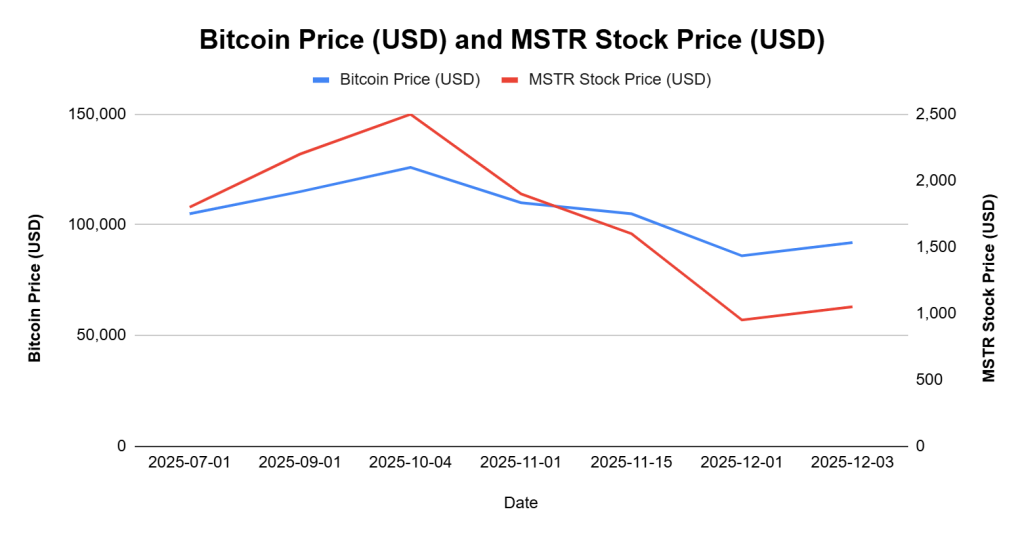
The impact on Strategy’s stock, traded under the ticker MSTR, has been even more pronounced. Shares have plummeted 60 percent year-to-date, underperforming Bitcoin’s own decline due to the company’s leveraged structure. For the first time in years, Strategy’s market capitalization, around 52 billion dollars, has fallen below the net asset value of its Bitcoin holdings, signaling investor skepticism about the sustainability of its model. This discount, or negative premium, reached as low as 0.87 times NAV in early December, a stark contrast to premiums exceeding 2.5 times in previous bull markets.
To fund its Bitcoin acquisitions, Strategy has relied on a complex capital structure involving convertible debt, preferred shares, and equity offerings. It carries about 8.2 billion dollars in debt, much of it low-interest convertible notes, alongside obligations for high-yield preferred dividends. The price slump prompted the company to slash its full-year 2025 Bitcoin yield guidance to between 22 and 26 percent, down from earlier optimistic targets, and its Bitcoin gain forecast to 8.4 to 12.8 billion dollars.
In response, Strategy has taken proactive steps to shore up its position. On December 1, it announced the establishment of a 1.44 billion dollar cash reserve, raised through equity sales, specifically to cover short-term obligations like dividends without resorting to Bitcoin sales. Additionally, the company purchased another 130 Bitcoins for 11.7 million dollars between November 18 and December 1, demonstrating continued conviction even amid the dip. CEO Phong Le emphasized in a statement, “We are not Bitcoin traders. We are Bitcoin investors,” underscoring the long-term hold strategy.
Michael Saylor, ever the evangelist, has maintained a public stance of defiance. Though recent social media activity from his account shows no new posts since late November, his prior messages reinforce the narrative of Bitcoin as “digital gold” and a hedge against inflation. This approach has garnered both admiration and criticism, with supporters viewing Strategy as a trailblazer in corporate treasury management.
Leverage Risks and Broader Market Implications
Strategy’s model is built on leverage, which amplifies both gains and losses. With 8.2 billion dollars in debt maturing over the coming years, including significant portions in 2028, the company faces fixed costs that could strain liquidity if Bitcoin’s weakness persists. Dilution from repeated equity raises has already frustrated some shareholders, and the recent cash reserve announcement, while stabilizing, involved further share issuance.
The most alarming risk is a potential “death spiral.” If Bitcoin falls another 15 percent, pushing Strategy’s market-to-NAV ratio deeper into discount territory, access to cheap capital could dry up. In a worst-case scenario, the company might be forced to sell portions of its Bitcoin holdings to meet obligations, flooding the market with supply and accelerating price declines. Given Strategy’s three percent share of total Bitcoin, such sales could trigger a 10 to 20 percent market crash, according to some estimates.
Comparisons with unleveraged alternatives highlight these vulnerabilities. BlackRock’s IBIT ETF, holding about 778,000 Bitcoins, offers direct exposure without corporate risks, tracking Bitcoin’s price with minimal deviation and low fees. Strategy, by contrast, trades at a variable premium or discount, making it a higher-risk play. Regulatory scrutiny adds another layer; MSCI is reviewing Strategy’s index inclusion for January 2026, and exclusion could prompt more forced adjustments.
Critics like Schiff argue the model is unsustainable, labeling it a “hype machine” that’s glitching in the face of reality. Proponents, however, see Strategy’s persistence as a bullish signal. Its small buys during the dip have helped stabilize sentiment, reassuring other institutions that major holders are not capitulating. In a market where psychology drives prices, Strategy’s position acts as an anchor, potentially capping downside and fueling rebounds.
Future Outlook and Conclusion
Looking ahead, Bitcoin’s trajectory hinges on several catalysts. A revival in ETF inflows, perhaps spurred by clearer Federal Reserve policy or positive economic data, could spark a Santa Claus rally. Conversely, prolonged macroeconomic headwinds might extend the bear phase into 2026. For Strategy, the 1.44 billion dollar reserve provides a buffer, but sustained prices below 85,000 dollars could test its resolve, with bankruptcy thresholds estimated around 23,000 dollars in extreme scenarios.
The broader lesson from Strategy’s saga is the double-edged sword of corporate Bitcoin adoption. It validates the asset’s maturity, drawing in traditional finance, but also introduces systemic risks tied to leverage and concentration. As Saylor often quips, “Bitcoin is the future of money,” yet current events remind us that futures are forged in the fires of volatility.
In the end, Strategy’s fate is intertwined with Bitcoin’s. If the cryptocurrency rebounds, the company could emerge stronger, vindicating its bold strategy. If not, it might serve as a cautionary tale for others eyeing similar paths. As markets watch closely, one thing is clear: in the world of Bitcoin, resilience is the ultimate currency.
