


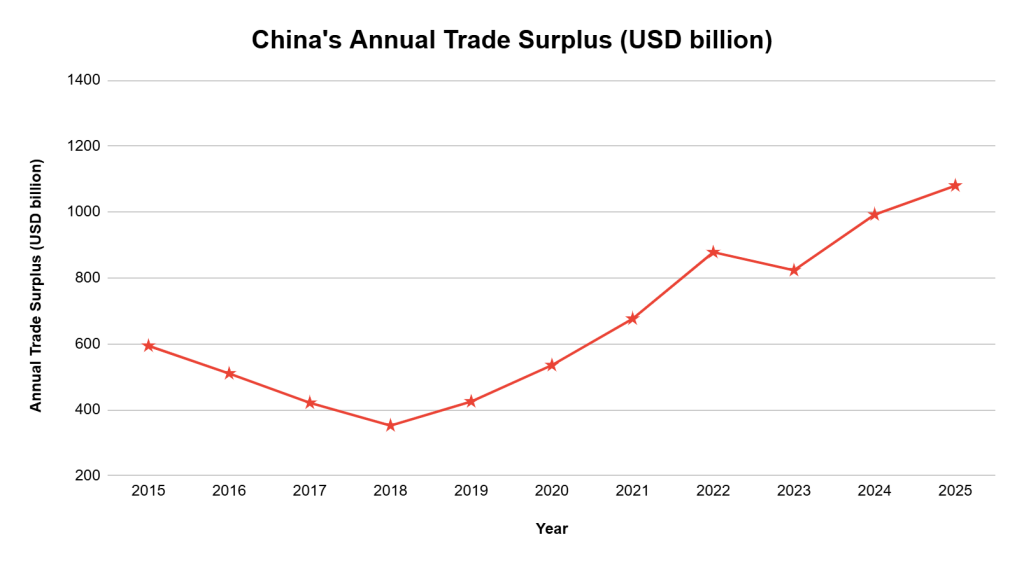
For the first time in history, a single country has recorded an annual trade surplus of more than one trillion dollars, and it did so before December even began.
On Monday, China’s General Administration of Customs announced that between January and November 2025, the country exported $1.08 trillion more than it imported. That figure already eclipses the full-year record set only twelve months earlier. November alone delivered a $111.7 billion surplus, the third-largest monthly haul ever recorded by any nation.
The United States, long the loudest voice in the trade-war chorus, watched its imports from China collapse by nearly 29 percent last month. Yet Beijing barely flinched. The goods simply turned elsewhere: exports to the European Union surged 14.8 percent, while shipments to the ten nations of ASEAN leapt 8.2 percent. Total Chinese exports still grew 5.9 percent year-on-year, as if the world’s highest tariff wall did not exist.
In the space of a single year, China has turned a punishing American trade war into the greatest export boom in modern economic history. The dragon has not merely survived. It has been crowned the undisputed monarch of global trade.
How the Crown Was Won
The victory rests on three pillars that no rival can match at scale.
First, industrial overcapacity on a planetary level. China now produces roughly twice as many electric vehicles, solar panels, wind-turbine blades, and lithium-ion batteries as the rest of the world needs. Beijing’s answer to weak domestic consumption has been simple: ship the surplus abroad at whatever price the market will bear, often below the cost of production in Europe or America.
Second, a deliberately competitive currency and an ocean of subsidies. Direct cash grants, cheap land, free electricity, and export-tax rebates keep Chinese goods artificially cheap. The yuan has been guided lower for much of 2025, quietly amplifying the price advantage.
Third, the greatest supply-chain pivot in history. When Washington slammed the door, Chinese manufacturers opened new factories across Vietnam, Indonesia, Thailand, and Mexico. Components cross an ASEAN border, a “Made in Vietnam” sticker is applied, and the finished product sails straight into Los Angeles or Rotterdam under lower or zero tariffs. ASEAN’s trade with the world is exploding, but the profits still flow back to the same Chinese owners.
The result? China now exports twice as much to the European Union as it buys in return, a deficit that will comfortably top €400 billion for 2025.
Europe’s Awakening
Brussels is no longer whispering about “de-risking.” It is shouting.
In October 2024, the EU slapped additional tariffs of up to 35.3 percent on Chinese battery electric vehicles, locking them in for five years from October 2025. BYD faces 17 percent, SAIC 35.3 percent, and even Tesla’s Shanghai-made cars carry a 7.8 percent penalty. Chinese EVs, which held less than 1 percent of the European market in 2019, are on course to claim 15 percent next year.
But cars were only the opening salvo. In 2025 alone, Brussels launched more than twenty new anti-dumping and anti-subsidy investigations, a modern record. Robotic lawnmowers, aerial work platforms, medical imaging equipment, wind-turbine towers, and wooden furniture are all in the crosshairs. Provisional duties on some products already range from 20.6 percent to 66.7 percent.
On 3 December 2025, European Commission President Ursula von der Leyen announced the first-ever “stress test” of the EU’s entire trade-defence arsenal, openly admitting that “entire European industrial sectors could be wiped out” by Chinese overcapacity and geopolitical shocks.
The political rhetoric has turned volcanic. Fresh from a three-day state visit to Beijing, French President Emmanuel Macron warned in Les Échos that Europe “will be forced to adopt measures as strong as those of the Americans” if the imbalance continues. Germany’s Foreign Minister Annalena Baerbock landed in China the same week with one message: overcapacity is now the central bilateral problem, especially for an auto industry that has never closed a German factory until Volkswagen announced exactly that in 2025.
Why Europe Still Lags Behind the Threat
For all the new weaponry, Europe remains fractured and cautious.
Germany, still China’s largest European trading partner, fears retaliation against its luxury cars and machinery. Hungary and Greece openly court Chinese investment. The EU has no equivalent to America’s Inflation Reduction Act or CHIPS Act, no trillion-euro chequebook to subsidise its own green and digital champions. And every time Brussels tightens the screws, Beijing reminds it who controls 90 percent of refined rare earths and 85 percent of permanent magnets.
The result is a strategy of targeted pain rather than strategic rupture. Europe is building a moat, but slowly, and the dragon is still swimming straight through the gaps.
2026: The Year the War Goes Global?
Analysts in Brussels and Beijing agree on one thing: the next twelve months will be decisive.
The Commission is already preparing cases on batteries, green steel, and possibly semiconductors. China, in turn, has opened investigations into European brandy, pork, dairy products, and large aircraft. Rare-earth export licences have been “delayed” for European firms that speak too loudly. Both sides are loading their magazines.
The biggest wildcard is Washington. If Donald Trump returns to the White House in January 2025 and follows through on campaign threats of 60 percent tariffs on China and 10 to 20 percent on Europe itself, the incentive for transatlantic coordination against Beijing becomes overwhelming.
An Uneasy Monarch
China ends 2025 richer, industrially stronger, and more dominant in global trade than at any moment since the Opium Wars. Its leaders can point to a trillion-dollar surplus as proof that the “China model” has triumphed over Western pressure.
Yet crowns forged from other nations’ deficits are inherently unstable. The louder Europe’s defences grow, the closer the world edges toward a true multi-front trade war, one that could finally force Beijing to choose between eternal export supremacy and genuine domestic rebalancing.
For now, the dragon wears the crown. Whether it keeps its head is another question entirely.
